Saturday, May 28, 2016

My Philadelphia Story - one of 780!


Of course an invitation like this would appeal to a Dumpster Diver!  "The artwork — a 20-foot-long shadow box packed with found and fabricated objects, each a pocket-size artifact of life in this city — is destined for Philadelphia International Airport’s Terminal F."


This image from an online Philadelphia Inquirer article shows Won Kyoung Lee and Matthew Alden Price, the husband and wife team behind this fascinating concept, and gives an idea of its scale.  Most exciting, each object will have an accompanying story. 

My submission, below, was accepted!  I am really looking forward to the opening and meeting Matt and Won in person.  Many Dumpster Divers will be part of this installation, which is so Diver-ish in spirit.


This is my accompanying story:

"My friend Elise had very special slippers she got in Chinatown.  When they wore out she couldn’t bear to just throw them away, so she snipped these sparkly chartreuse flowers off the toes and gave them to me, knowing I would put them to use in art. We are both happy they have another life now.  I moved here from San Diego in 2010 not knowing anyone. I love that my new Philly friends know to save their ‘trash’ for me.  What I love about being a found-object artist is the sense of story and personal history of objects.  Being one of the Philadelphia Dumpster Divers, I am thrilled to have found kindred spirits."

 I am proud that my Philadelphia story will be one of the 780 objects with accompanying stories of myphiladelphiastory.com/!




Monday, May 23, 2016

Multiple Visions: A Nation of Immigrants


In the midst of this strangest of political seasons, I'm grateful that the Art Gallery at City Hall in Philadelphia is mounting an exhibit called VOTE, that will be on display through the Democratic convention.  Mr. Tu Huynh, Program Director of the Gallery, invited the Philadelphia Dumpster Divers, along with CFE VA, Inliquid, Schuylkill Art Center, University City Arts League, Mt. Airy Art Garage, ArtWell, Village of Arts and Humanities, Pennsylvania School for the Deaf, HMS School for Children with Cerebral Palsy, and Cultural Center of SpArc Philadelphia to participate.  I'm so happy to be a Dumpster Diver and be part of things like this!

 I just submitted "Multiple Visions: A Nation of Immigrants", which I made specifically for the VOTE exhibit. The microfilm, the Archives logo (from the microfilm box), and the Petition for Naturalization photo are ephemera that were given to the Dumpster Divers by the National Archives.  The ballot stubs were saved from when I lived in San Diego County.  As I was making this, I realized how fortunate I was to have lived in a border area for over thirty years, infused with Mexican language, music, food, art, and culture.  It was a privilege to live in a bi-cultural area. 


 The liberty coin atop the peaceful silver scene conveys that liberty includes a sense of safety, a place to have a home and raise one's family.  I think of J.S. Bach's "Sheep May Safely Graze".  The United States has always been a haven for people who were not safe in their countries of origin.  The Petition for Naturalization indicates a man from Greece born in 1883, occupation 'Peddler', and is a reminder of our long history of being open to immigrants.  My vote says may that not change now!  Let's hear it for having multiple visions!  I'm glad Multiple Visions has a guardian angel...

I also submitted this piece, "You Are Needed", which again makes use of National Archives ephemera, including the vintage background poster, and was in the Dumpster Diver exhibit at the National Archives in 2014, "Archives Alchemy."


I will await word from Tu Huynh as to whether either or both of these will be included in the VOTE exhibit.  Wish me luck!


Saturday, May 21, 2016

Counting the Omer - Day 28


"We remember our grandparents, our great grandparents and all those whose actions have helped us to create our lives.  And we remind ourselves that we, right now, are shaping the world for those who will someday call us ancestors."

That text for day 28 from Rabbi Yael Levy's Counting the Omer, A Journey Through the Wilderness, resonated so deeply with me that I copied it into the Visual Journal I made in 2011, when I first learned to count the Omer.  

The image is a copy of a photo etching I made many years ago that includes a picture of my grandmother, my mother's handwriting showing her mother's dates as 1874-1952, a footprint from my own birth certificate, and Hebrew fragments from the Kaddish, the mourner's prayer. 

 In addition to Rabbi Levy's guide, I also use this more traditional guide:


Sometimes the challenge is in figuring out the relationship of the two different approaches!  Rabbi Levy names today, the 28th day, "Shechina Sh'b Netzach / The Flow of Eternity".  She is emphasizing this fourth week of Netzach as Eternity,  and the particular quality combining with it for the last day of the week as Shechina, or the feminine aspect of the divine.  Rabbi Jacobson names today as "Malchut of Netzach / Nobility in Endurance".  Malchut is the kingship, masculine aspect of the divine. What is the relationship of The Flow of Eternity with Nobility in Endurance?  


I don't  know the answer, but I can see from this image of the Tree of Life that each branch has many other branches as well, and many many more leaves!


Monday, May 16, 2016

Still Counting the Omer


I saved this calendar page for years, intrigued by the beautiful 18th century cabinet that was an aid for keeping track of the Omer count.  It was both exotic and a mystery to me.  Yesterday I made a SoulCollage® card about the opportunity that counting the Omer gives us to dive deep in unexpected ways  - an opportunity both so old and so new.


Because of the size limitations of SoulCollage® cards (5" x 7"), I only used the central portion of the Omer counter image.  Suddenly it made sense:  the counter is set to "Day 21, making three weeks of the Omer."  The bottom square is a flower because Day 21 is three weeks even with no additional days.  I made the card on "Day 22, making three weeks and one day of the Omer".  The top knob would have been turned to 22, the middle knob would stay the same, and the bottom knob would have been turned to 1, changing the flower to a number.

I suspect that the Hebrew on the right side of the uncut image are the prayers recited with counting, and that the letters on the left refer to the categories in the center.

Suddenly a museum artifact, a beautiful object connected with a quaint ancient custom, became functional.  I feel a bond with the people who used it, as well as with all the divers of today who are exploring the Tree of Life through counting the Omer.


Sunday, May 1, 2016

Omer Count Time Again!


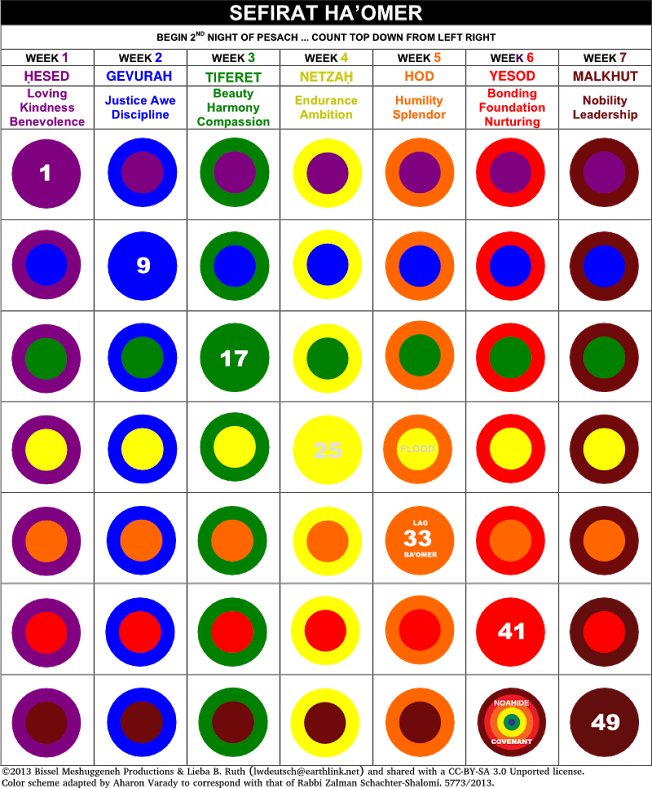
I have gotten a slow start to this year's Omer Count - the 49-day period of mindfulness practice between the second night of Passover and Shavuot, the festival of Revelation at Sinai. People have been counting the Omer a long time.  You can see from the contemporary counting chart above that the secret is the intersecting of two qualities with each other so that each day is a unique combination. 

Flying across the country with a terrible cold, evenings in airports, mixed up time zones, and needing to sleep a lot was not conducive to Omer counting.   It was all worth it for having spent the beginning of Passover with my daughter, son-in-law, and grandsons in San Diego!  

In 2014 I wrote on one of my Omer Count Visual Journal pages "Last night I was sick and fell asleep before I counted so counted this morning.  Even the awareness of having missed it last night counts...The desire to count counts."  From that point of view I did manage to count.


Jewish mystics of the 16th and 17th centuries turned what had been a Spring agricultural festival into an opportunity for deep spiritual practice, guided by the qualities of the lower seven of the ten Sefirot, or Divine emanations. These Kabbalistic Sephirot are shown above. They are often shown corresponding to points in the body, as below:


Being dyslexic, I find this confusing.  E.g. Chesed, or Lovingkindness corresponds to the right arm.  In the image above it is on the right, but is actually the person's left arm.  


In this image, Chesed does correspond with the person's right arm, but since he is facing us it is on the left.  The image below works best for me:  Chesed is on the right and correlates with the person's right arm because he is facing away from us. 


Friday night, Shabbat, began the 7th day, making one week of the Omer.  I had not been well enough to make any new visual journal pages to go with my counting, but at least realized that I needed to move my counting materials out of my office and down to my studio, near my art materials! It helped to finally feel well enough to get to my studio at all. 

Today, is still the 8th day.  It won't be day 9 until sunset tonight, so it is still Chesed within Gevurah / Lovingkindness within Discipline.  Counting the Omer makes one very aware of counting days from sunset to sunset.  It feels good to have started my visual journal for this year's Omer count this afternoon.  Six more weeks to go! 


This beautiful ancient Omer counting chart is a reminder that this is a very old journey.  I'm grateful it is being made new again, by people like Rabbi Yael Levy, who introduced me to it in 2011.  Her book, Counting the Omer, A Journey Through the Wilderness, has been one of my maps ever since.


Friday, April 8, 2016

Cuba On The Cusp


This mixed media piece, "Cuba On The Cusp", captures impressions from my visit to Cuba last February.  I purchased the vintage game board that forms its background in a plaza in Havana that is surrounded by booksellers, as well as vendors of posters and other memorabilia:


It is actually a menu from an ice cream company when folded closed.  When opened, presto!  A game board!  I knew it would be one of the best treasures from my trip:  an art supply that could easily fit in my suitcase!

Another treasure that was easy to carry was the coin with Che's iconic image that says "Patria O Muerte" (Country or Death):


People were selling these coins on the street to tourists.  I'm not sure if these coins are even still in circulation as legal tender.


It fit perfectly on the game board.  Che projects an aura of liberty and freedom that for me is actually more truly embodied by Jose Marti. However Jose Marti wasn't quite as romanticized or photographed as Che, as well as being from an earlier era, not contemporary with the revolution.  I couldn't resist my choice of computer keyboard keys near the coin.  Once Cubans have readily available uncensored internet access, they will be able (among many other things!) to examine the many-sidedness of Che's legacy.  
 

Earlier sketches of this piece were somewhat different.  It wasn't until after Obama's historic visit to Cuba in March that I added the digital phone circuitry and computer keyboard pieces.  It was so hopeful that among the businessmen who accompanied him were internet technology people.  Cubans have cell phones on which they can call each other and text, but for the most part they don't have internet access. 


In contrast, the the curved metal piece on top of the shoe sole is an old typewriter key..  


The sole echoes arches in so much of Cuban architecture, whether in crumbled ruin:


 or in the renovated tourist areas:


The old-fashioned ruler and toilet handle are symbols of the explosion of renovation that is going on in Havana, at least in the tourist areas:


The circular blades on the bottom recall boats, whether fishing boats, the boats of the Mariel boatlift of 1980, (a mass emigration of Cubans to the United States), or the boats of people who have attempted to leave, both successfully and unsuccessfully, in the ensuing years.


"Cuba On The Cusp" points to the convergence of old and new.  The 'shift' keys point in both directions.  Change is accelerating.  The hand in the center expresses the  love of the land, its culture, and its people that gives me confidence that the essential nature of Cuba will endure.  It always has.  It is resilient and beautiful.  And the new forms will be fascinating! 


Friday, March 25, 2016

Good Friday Then and Now


These passionate floats were lined up in a plaza in Girona, Spain on Good Friday 2008, waiting to be in procession on Easter.


We were there with a Jewish history tour of Portugal and Spain.  I was looking for a glimpse of La Convivencia, "The Coexistence," the past time when Jews, Muslims and Catholics not only got along, but experienced a rich and deep cultural interplay.  It did fall apart, but it did also exist.  What might we learn from La Convivencia?  That insight is more urgently needed now in 2016 than it was in 2008.


This Museum of Jewish History in Girona is around the corner of the plaza where the floats were.  We got there fifteen minutes before it closed early for Good Friday.  The employees were Catholic, and were being given time off for the holiday.  

As it is this year, in 2008 Purim was close to Easter.  The previous evening, some of our group had gone to the synagogue in Barcelona to celebrate Purim.  They reported a festive time, enclosed in careful security.  The men were instructed to remove their kippot, (skullcaps), upon leaving - that is, to remove overt signs of being Jewish.  The group was told to disperse quickly afterwards, or go back into the building while waiting for the bus.  Historically, Good Friday had been a time for attacks on Jews, accused of being Christ-killers.  


 We saw this stencil repeated on many walls in the city, urging rejection of fascism.  It made the Good Friday anti-Semitism  feel visceral, especially when I saw the one where someone had scratched a fresh swastika. 


Also disturbing was this costume, seemingly connected with an Easter ritual. Who are the Hermanidades?


All I could think of was the KKK.  I have no idea where their costumes originated.  But what is this medieval Spanish tradition which persists?  


If resurrection really does follow Good Friday, then may we all rejoice in the renewal of nature at this blossoming season, and experience a blossoming in our hearts towards each other, including towards the millions of refugees and immigrants, displaced by violence, war, and oppression around the world.