Thursday, July 31, 2014
Newark Museum - I Love It!
I was thrilled that the Arts of Africa section at the Newark Museum included contemporary art! I had seen a lot of the work of Moroccan-born UK-based Hassan Hajjaj online. His series 'Kesh Angels, on the biker culture of the women of Marrakesh, had made a big splash this year at a New York gallery. He's one of those international superstar artists who also does performance, fashion, interior design, and furniture. This was the first time I had an opportunity to see his work in person. I somehow hadn't realized that his borders aren't flat. The metal cans are intact in their cubby holes - fully 3-D objects. Art on a monitor just isn't fully seeing. (Better than not seeing it at all though I guess.)
Here's two more of his that weren't at Newark, just for fun because he is so cool:
I also enjoyed this "Sparkplug Lady" by Olu Amoda (born 1959, Nigeria; lives and works in Nigeria). Welded used sparkplug, screw driver, and steel. Talk about found object art!
This textile commemorates Barak Obama's election and his first presidential visit to Ghana in 2009:
And of course, "Dry Season" by Nnenna Okore (born 1975, Nigeria; lives and works in Chicago). Handmade paper, jute rope, burlap and dye. "Okore transfigures urban detritus into art...A former student of the Ghanaian artist El Anatsui, Okore belongs to an artistic movement concerned with the culture of recycling in her Nigerian homeland." So beautiful and iconic.
One more reason I fell in love with the Newark Museum today.
A Jewel of a Museum in Newark!
I couldn't stop watching this installation by Andrew Demirjian called "Morning Light". I don't know how long the loop was, but every time I looked it was different. He used more than twenty unwanted televisions. I've seen these kind just sitting by the roadside..
It is part of the NJ Arts Annual, called Ready Or Not, with work by 40 New Jersey-based artists. It wasn't why I went to the Newark Museum today, and I wasn't ready for it! What a total surprise and treat!
I got carried away. I couldn't help myself. I'd leave, go to another gallery, come back - and see something I hadn't seen before. The blurb said all kinds of stuff about examining excessive consumption and an analogy to elderly humans in a capitalist culture. Yeah, yeah, yeah. For me it was about sheer visual beauty!
Tuesday, July 1, 2014
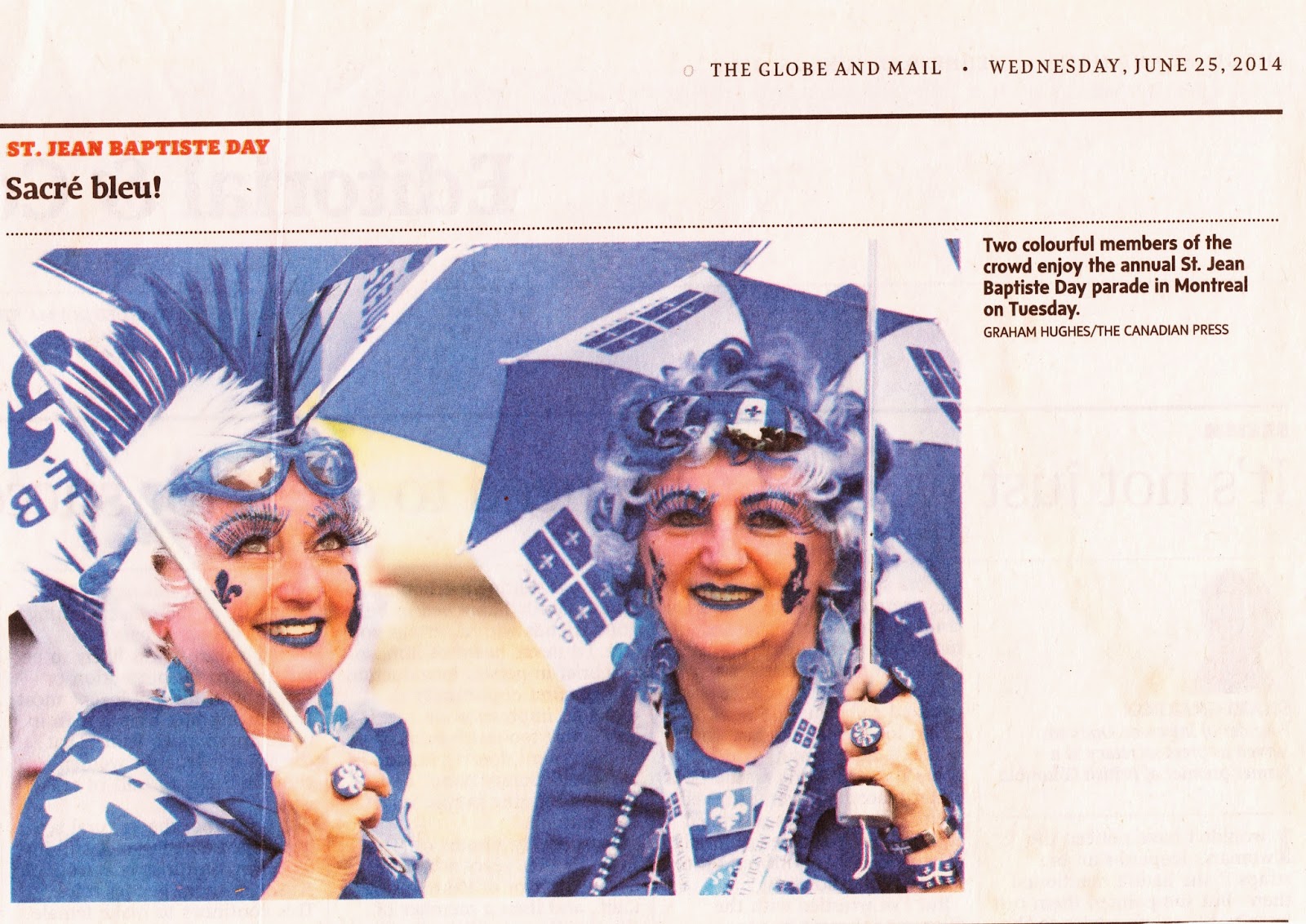
Sacre Bleu! Who Knew?
We had no idea that St. Jean Baptist Day, otherwise known as Fete Nationale, would take place on June 24th during our Montreal vacation. It celebrates the French culture, heritage, and history of the Province of Quebec. The English newspapers made no mention of it that day, but at least included the picture above on the following day - with no article. The French newspapers were another story!
Everything was closed. The downtown business district was deserted as if it were a Sunday. Shops and museums were closed. The post office was closed:
Even the grocery store was closed:
Places to celebrate and party, like restaurants and bars, were open. It made the history of Quebec very real, including the history of its separatist movement. Today the separatist political party is a minority. As one French Canadian told us, "we don't need separatism anymore, because Quebec is essentially autonomous under the umbrella of Ottawa," implying that the goals of the separatist movement were achieved without secession.
It was fun to be there to catch the spirit. I understand why an English speaking resident of Montreal, although a minority, said that there's no where else he would rather live!
Monday, June 30, 2014
Montreal: Graffiti and Murals and Public Art - Oh My
Art of every kind is everywhere on the streets of Montreal. Some murals are even funded by the government, if an artist's proposal is accepted. One percent of the cost of buildings is set aside for public art.
On this wall in Chinatown, I love how the graffiti peeks out above the bas relief of gracious musicians.
These large sculptural blocks were all over town, in a variety of bright colors, alerting people that a new public art work would soon be seen in that location.
By checking out facebook.com/bureaudartpublic I found this image from Stephen Schofield's studio and the work in progress that will ultimately be where the green block is now:
This landmark public art work, The Illuminated Crowd, is by Raymond Mason, done in 1985 in stratified polyester resin with polyurethane paint. I don't particularly like it, but it is definitely a phenomenon:
It's a little creepy..
Even the firehouse had its own murals:
It was great to be in a city that values art and artists!
Sunday, May 25, 2014
Conserving Stories: A Mixture of Science, Art, & Love
Getting the personal tour by my conservation guru, Lara Kaplan, of the twenty-six conservation studios, laboratories, examination rooms and workshops in the Research Building at Winterthur Museum & Garden was an amazing experience. She is faculty on the Winterthur/University of Delaware Art Conservation program as well as a graduate of it, so was able to arrange for my mukluks to be treated in their freezer. Here she is examining an everyday item from the early twentieth century. I remember my mother wearing rain boots like that! As a conservator, she is part anthropologist, part art historian, and very much part scientist.
Above is the textile lab. The freezer is against the wall to the left of the yellow box marked "flammable". The items in front of it which looks like they are sitting on dish drainers, are in their 24 hour thawing period after being in the freezer for 72 hours. My mukluks will have two cycles like that before I pick them up.
Here is another shot of the textile lab. It has the largest bath I have ever seen.
This is the graduate student classroom. It is a three year program, with pre-requisites in chemistry, as well as anthropology, studio arts, and more. Ten people to a class, with two years here, and a third year interning anywhere in the world makes for a very special club.
This is the painting restoration lab, where people know how to identify forgeries, and would know how to make forgeries. Like black hat and white hat hackers, these are the white hat painting restorers!
Is it a chemistry lab? Is sure looks like one, but it's a conservation lab!
Books and paper conservation each had their own labs.
This lab repaired broken ceramic and china objects, and I'm not sure what else. There was so much that my head was swimming.
The students present posters at various conferences. Some of them lined the hallways, like this one.
The furniture conservation lab was extensive. An interne from a local college was working in it.
It was special to finally meet Lara after all our email correspondence, and it was a treat to get the tour of the conservation labs. It was serendipity to also meet Bruno Pouliot, Winterthur's Senior Conservator of Objects. It was the first time in forty-five plus years I had the opportunity to speak with someone who had also lived in the Arctic! He had been a conservator in Canada for six years, and it turned out that in my journey through three referrals to finally find Lara on the fourth try, he was the connecting link! A man who knows mukluks and Inuit culture from experience, he understood that it is not the object alone we are conserving, but the stories that go with it... The bond between us in just a few minutes of conversation is beyond words.
Subscribe to:
Posts (Atom)