Friday, March 25, 2016

Good Friday Then and Now


These passionate floats were lined up in a plaza in Girona, Spain on Good Friday 2008, waiting to be in procession on Easter.


We were there with a Jewish history tour of Portugal and Spain.  I was looking for a glimpse of La Convivencia, "The Coexistence," the past time when Jews, Muslims and Catholics not only got along, but experienced a rich and deep cultural interplay.  It did fall apart, but it did also exist.  What might we learn from La Convivencia?  That insight is more urgently needed now in 2016 than it was in 2008.


This Museum of Jewish History in Girona is around the corner of the plaza where the floats were.  We got there fifteen minutes before it closed early for Good Friday.  The employees were Catholic, and were being given time off for the holiday.  

As it is this year, in 2008 Purim was close to Easter.  The previous evening, some of our group had gone to the synagogue in Barcelona to celebrate Purim.  They reported a festive time, enclosed in careful security.  The men were instructed to remove their kippot, (skullcaps), upon leaving - that is, to remove overt signs of being Jewish.  The group was told to disperse quickly afterwards, or go back into the building while waiting for the bus.  Historically, Good Friday had been a time for attacks on Jews, accused of being Christ-killers.  


 We saw this stencil repeated on many walls in the city, urging rejection of fascism.  It made the Good Friday anti-Semitism  feel visceral, especially when I saw the one where someone had scratched a fresh swastika. 


Also disturbing was this costume, seemingly connected with an Easter ritual. Who are the Hermanidades?


All I could think of was the KKK.  I have no idea where their costumes originated.  But what is this medieval Spanish tradition which persists?  


If resurrection really does follow Good Friday, then may we all rejoice in the renewal of nature at this blossoming season, and experience a blossoming in our hearts towards each other, including towards the millions of refugees and immigrants, displaced by violence, war, and oppression around the world.


Tuesday, March 22, 2016

The Spirit of Jose Marti

This corner of hommage to Jose Marti, the "Apostle of Cuban Independence" is in the Callejon de Hamel, the center of Afro-Cuban Santeria religious traditions in Havana.  As only art can, it conveys the reverence for his spirit.

Today, March 22, 2016, President Obama laid a wreath at the Jose Marti Monument in Havana.


My group arrived in Havana on January 30th, 2016, two days after Jose Marti's 163rd birthday. Freshly back, I have been moved by President Obama and his family's visit to Cuba. (I just found out his mother-in-law was along too.  I think the Cubans resonate with three-generation families.)  I have read and saved the text of Obama's momentous speech that was broadcast on Cuban television today, and around the world. 


This is the typewriter in the Museum of the Revolution in Havana on which Fidel's famous "History Shall Absolve Me" speech was typed.  Today, Obama's speech is archived forever in every possible media format.  Last I looked, it wasn't posted yet on YouTube, but it will be.

What a great statesman he will be in his post-presidency.  Today, on Cuban national television, he said (among other things) that both countries needed to do more to overcome racism due to a history of slavery - something promised in both countries, but far from achieved.

The Callejon de Hamel was fascinating, not only artistically, but also because of its honoring, cherishing, and practicing of African traditions, now become Afro-Cuban.  


I can't resist sharing some of the more striking images from the Callejon:


 This was the most amazing though, in the Santero's art studio:


Our guide was reading it.  It turned out he was getting his Masters degree at the University of Havana and writing his thesis on why the revolution did not bring an end to racism. The quintessential 21st century Santero!  And today he could watch the president of the United States - a Black man, speaking in Havana - say that there was racism in both countries which needs to be addressed. 

I thought my interest in Santeria was intellectual curiosity.  I found this painting of Elegua, an Orisha, or spirit in the Afro-Cuban Santeria tradition, in a market.  No other Orishas were available.  And only one of Elegua.  It found me. He is master of the paths, crossroads, and gates of this world.  Now he hangs in my studio and remains a presence. 


I have a feeling that Elegua has been very active in Cuba lately, opening doors and opening hearts...


This is Jose Marti's jacket, vest, and shirt in the Museum of the Revolution.  It was perfect for Obama to lay a wreath at Marti's monument today.  I was in Havana for only a short time, but one can feel the spirit of Jose Marti infusing new generations with his concepts of freedom, liberty, and democracy. It was especially strong in Callejon de Hamel, as you can see in the image at the top. The future for all of us is so hopeful.


*******************************

I haven't posted a blog since last October.  I thought I was done with it, but this was too important and emotional.  The photos are mine, except for Obama laying the wreath.


Saturday, October 10, 2015

A Synagogue in a Prison?


We visited Eastern State Penitentiary in Philadelphia today thinking it would be a fun outing with our niece.  I didn't know there was a synagogue in it.  Nor did I guess how unexpectedly moving it would be.


Eastern State closed in 1971, and today is a big tourist attraction in a state of 'stabilized ruin', "a haunting world of crumbling cellblocks and surprising eerie beauty."  This wreckage of the original synagogue is pretty much what the interior of the cells looks like, though of course much smaller.  In 2004 "the decision became clear:  save what could be saved, learn what could be learned, and carefully piece this sacred place back together."  

Today it looks like this:


There is even a side room with a basket of kippot (skullcaps) on a table as if about to be used:


In the Exhibit on Jewish Life, there was a video of the Rabbi who was the visiting Chaplain talking about bringing in special kosher foods for Passover.  Here they are holding a Seder in the Synagogue.  The inmates feasted on all the traditional delicacies so foreign to their normal fare, with enough leftovers to take back to their cells to share or barter with the non-Jewish prisoners. 


Sheldon Glasshofer also spoke on the video, about how they got to together at Seders and discussed the Passover story, as Jews everywhere always have.  Except that these Jews were discussing a holiday of freedom and liberation from inside a prison.


Services first began with High Holidays in 1913 / 5674, with an inmate leading:


Weekly Shabbat services were added by 1917, with much support from the Philadelphia Jewish community:


It's remarkable the extent to which the prison administration accommodated to Jewish ritual and custom, and for such a small percentage of of their population. The Synagogue skylights were even opened up at Sukkot, turning it into something of a virtual sukkah.

Perhaps it helped that the President of Eastern State's Board of Trustees was Alfred Fleisher.  After his death The Alfred W. Fleisher Memorial Synagogue was named in his honor.  


The original synagogue door is carefully preserved.  You can see the "ghosts" of the two Stars of David on the upper panels:


The mezzuzah  currently in use on the doorpost is a reproduction:


It was touching to see that the local Jewish community is obviously still active in both preserving and teaching about this unusual history.  The invitation to fill out cards about both good deeds done or good deeds done for you were filled out and posted by children who had visited from all over the world.


I'm glad we visited Eastern State Penitentiary, and I'm surprised and touched to have visited both the synagogue and the accompanying exhibit on Jewish Life in the prison.  People talk about the "ghosts" in Eastern State, and Halloween season is their time to stage a massive haunted house.  I don't know about ghosts.  I know I felt the presence of this unusual congregation who together with many volunteers from outside the walls made this space very sacred.


Wednesday, April 15, 2015

Cherry Blossoms and Shoes


The cherry trees in Washington D.C. last Saturday were stunningly beautiful.  I escaped the crowds that were milling around the National Mall admiring the phenomenal trees and taking photos of 'family at Cherry Blossom Festival', as if sprung out of their houses like the blossoms from their buds. Instead I ducked into the Arthur M Sackler Gallery, http://www.asia.si.edu, to see an exhibit by Chiharu Shiota, a Japanese installation artist born in 1972 in Japan who has been living in Berlin since 1996.  

I had seen a lot of her work online and knew I was a fan.  This was my first experience of seeing an actual installation that I could walk around and see from various angles as well as close up. Wow.  What a reminder that we think we see art online, but it's no comparison to the real thing!  She has worked with the shoe theme many times in various locations around the world and in different ways.


The one above was done in Berlin in 2008.  Like Chiharu Shiota, I am touched by the life of objects and the stories they tell about the people who previous used or wore them.  In the Sackler installation she had people write notes that told stories about each particular shoe.  The translations from Japanese can be found at  http://www.asia.si.edu/shiota/map.asp/.  The note attached to the sneaker below says:  "The time they were worn: November 2005 to October 2007. Place: from my home to my work place and the pilgrimage of Shikoku’s 33 temples. The memory: These were familiar shoes. When it rained, water went into the shoes. At the end of the life of the shoes, I wore them only when it was nice out. When I did the Western pilgrimage of the 33 temples they served my purpose very well. In addition, every time I went out running, the laces became loose."  So personal and individual...


Shiota has said that she visits each location before she does an installation to make each one uniquely site-specific.  The one at the Sackler was clearly influenced by the light from the windows, which changed over time and therefore created changing shadow patterns of the red threads.  


There is something so tender and poignant about worn shoes.  These were Mikhail Baryshnikov's.....


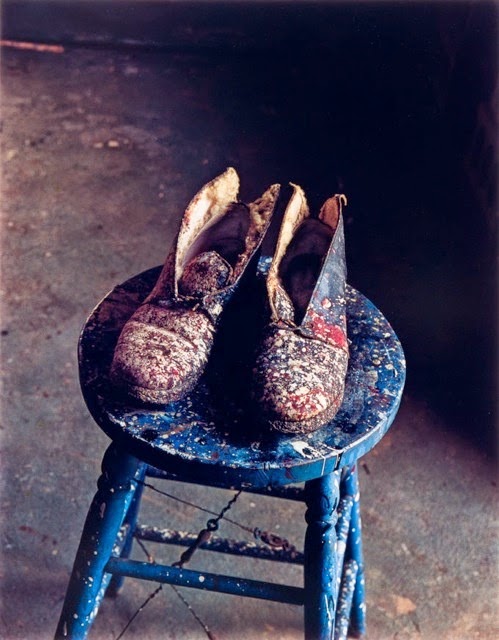
These paint paint covered shoes belonged to Lee Krasner, photographed in the Pollock-Krasner studio in Long Island in 1988.  The stool feels like an altar.


Artist Elina Chauvet created this installation "Zapatos Rojos" (Red Shoes) in 2012 - more than 200 red shoes in honor of the hundreds of women and girls who have been killed in Ciudad Juarez, Mexico. She didn't have to be aware of Chiharu Shiota's work - it's just something about shoes as a metaphor for the person.


These boots once belonged to Jesus Alberto Suarez del Solar, 1983-2003.  I saw them at a Dia de los Muertos celebration in Carlsbad, California in 2005, at the booth of "Proyecto Guerrero Azteca"  "una voz contra de la guerra in Irak."  (Aztec Warrior Project, a voice against the war in Iraq).  

The shoes below are one of the SHOES OF MEMORY: HOLOCAUST CERAMIC WORK by Jenny Stolzenberg. She made seventy pairs of ceramic shoes for an exhibition that echoes the piles of shoes, clothing, hair, glasses and suitcases found in the warehouses of Auschwitz at liberation and evoke the memory of those who perished. Meticulously researched and rendered in clay, Stolzenberg’s shoes return a sense of identity to the victims of the Holocaust by rescuing the shoes from their anonymity in the piles at Auschwitz.


Shoes have played a role in my own work as well, and I gather them at thrift shops and garage sales whenever particular ones catch my eye.  This piece actually makes use of a sneaker that had been my father's.  


I'm so glad that Chiharu Shiota will represent Japan at the 56th Venice Bienniale this year!  This time she plans to use keys in her installation.  She asked visitors to the Sackler to leave unused keys in a box, feeling they will tell the story of the person who once used them, the places they unlocked, the hands who once touched them...  Go Chiharu!!!


Friday, October 10, 2014

A Sukkot Mystery


Every Sukkot since visiting El Transito Synagogue in Toledo, Spain in 2008 I remember a particular treasure in its women's gallery. 

The women's gallery upstairs was intimate and touching. A wooden chair was  so tiny it looked child-sized! Most astonishing, in the exhibit of life-cycle and holiday objects, was an actual etrog, (a yellow citrus fruit), together with a lulav, (palm, myrtle, and willow branches bound together). These ritual objects are shaken together in a prescribed manner during Sukkot, a Fall harvest festival. I had seen many etrog boxes, both ancient and modern, in Jewish museums - elaborate silver, ceramic, or inlaid. I had never before seen just the plain ancient piece of fruit itself. This etrog was shriveled, dry, slightly reddish like brick, almost looking like a large nut. The branches of the lulav were dried and brittle, no longer green. How long since that particular etrog and lulav were held in the hands of Jews of the Toledo community?  

Jews were expelled in 1492, and El Transito, built around 1400, was converted into a church.  Now it is part of the Sephardi Museum, which explores Jewish culture of medieval Toledo.  Were that shriveled lulav and etrog somehow preserved since before 1492? If so, how did they survive?  What were the travels of the hands that had held and shaken them, if they dated from descendents of expelled Jews who had since returned?  There was something about seeing actual dried up plants - a fruit and branches - that felt like a more personal and immediate connection with the people whose hands had touched them, than with objects like candlesticks or torah decorations that one sees more often in museums.  It was poignant and real.

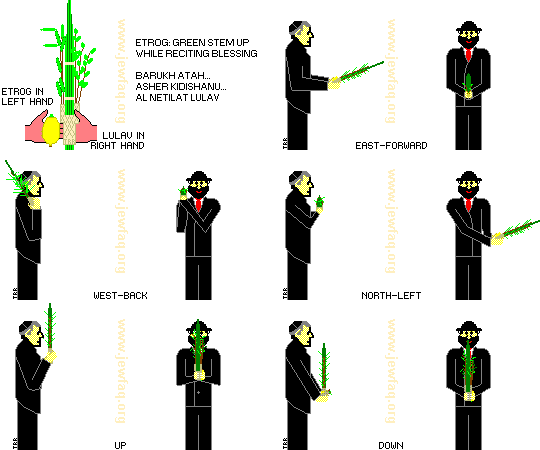
Following is the official ritual:  Stand facing the east (or whatever direction is toward Jerusalem from where you are). Take the etrog in your left hand with the stem (green tip) up and the pitam (brown tip) down. Take the lulav (including the palm, myrtle and willow branches bound together) in your right hand. Bring your hands together and recite the blessing below. After you recite the blessing, turn the etrog so the stem is down and the pitam is up. Be careful not to damage the pitam! With the lulav and etrog together, gently shake forward (East) three times, then pull the lulav and etrog back in front of your chest. Repeat this to the right (South), then over your right shoulder (West), then to the left (North), then up, then down.  In recent years, some have added a seventh dimension :  Inward.


Waving Procedure - Animated GIF


Spending time with Native American people in the San Diego area has deepened my appreciation of rituals that honor the four directions, as well as sky and earth. Although there are various mystical interpretations in Jewish tradition for this ritual of Sukkot, East, West, North, and South, Sky and Earth are common to us all.